
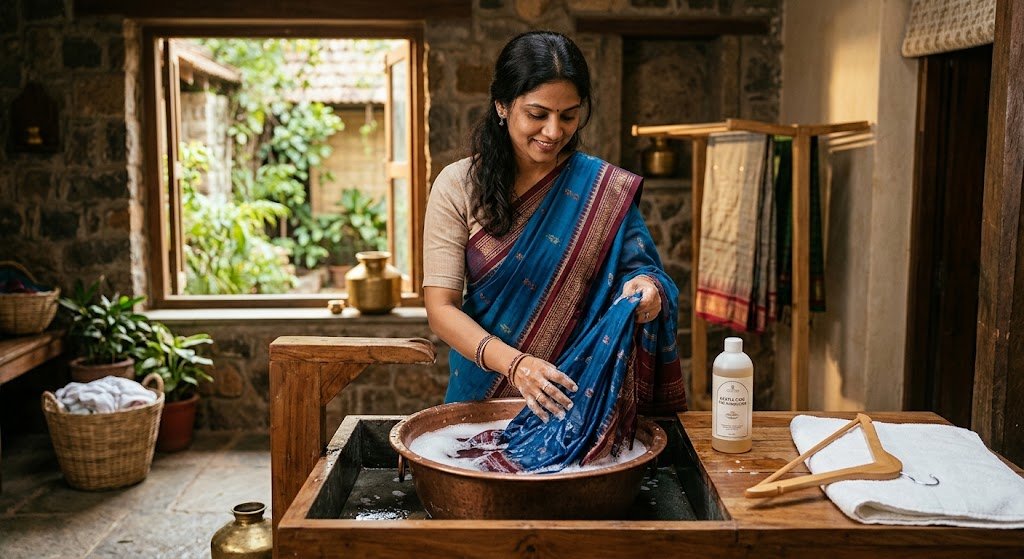
How to Care for Your Pure Handloom Saree: A Complete Guide to Washing, Stains, Ironing & Storage
A pure handloom saree is more than a piece of clothing. It represents the skill of the weaver, the character of the yarn, the beauty of traditional weaving and, in many cases, hours of careful craftsmanship.
When you invest ₹15,000–₹20,000 in a pure handloom saree, proper care becomes essential to preserve its colour, softness, texture, weave, zari, borders and original beauty for years.
Unlike ordinary machine-made fabrics, handloom sarees can be more sensitive to excessive washing, harsh detergents, friction, moisture and direct sunlight. The right care routine can significantly extend the life of your saree.
1. First Rule: Always Check the Fabric
Before deciding how to wash or clean your saree, identify the fabric.
Different handloom sarees require different care:
- Pure silk
- Silk-cotton
- Pure cotton
- Linen
- Tissue
- Organza
- Zari or zari-bordered sarees
- Naturally dyed handloom sarees
- Embroidered or embellished sarees
Never assume that every handloom saree can be washed in the same way.
For an expensive or delicate saree, follow the care instructions supplied by the weaver or seller. If there is uncertainty—particularly with silk, zari, embroidery or a saree with possible colour bleeding—professional textile cleaning is safer than experimenting at home.
2. Should a ₹15,000–₹20,000 Handloom Saree Be Washed at Home?
For premium handloom sarees, home washing should not automatically be the first choice.
Silk and other delicate natural fibres can be affected by water, agitation, rubbing and inappropriate detergents. Research on textile conservation also indicates that silk is less stable during aqueous washing than some other common fibres.
For delicate silk sarees:
Prefer professional dry cleaning when recommended by the manufacturer/weaver.
Tell the cleaner clearly:
"This is a pure handloom saree. Please inspect the fabric, colour fastness, zari and embellishments before cleaning."
Choose a cleaner who has experience handling silk and premium Indian textiles, rather than treating it like an ordinary garment.
Dry cleaning itself is not automatically risk-free. Conservation literature notes that cleaning can create physical and chemical stresses in delicate textiles, so cleaning should be performed only when necessary and by someone experienced with the specific fabric.
3. Never Use a Washing Machine for a Precious Handloom Saree
A washing machine can expose a saree to:
- Excessive agitation
- Friction
- Twisting
- High-speed spinning
- Detergent concentration
- Colour transfer
- Damage to delicate zari or embroidery
These processes can affect the weave, surface texture, borders and drape.
For a premium handloom saree, particularly silk, machine washing is best avoided unless the manufacturer specifically states that it is suitable.
4. Avoid Harsh Detergents
Do not use:
- ❌ Bleach
- ❌ Strong detergents
- ❌ Fabric whitener
- ❌ Washing powder meant for heavily soiled clothes
- ❌ Strong stain removers
- ❌ Chlorine-based products
- ❌ Unverified home remedies
Chlorine bleach is particularly dangerous for silk and wool because it can severely damage the fibres.
Also avoid experimenting with baking soda, lemon, vinegar, alcohol or other household chemicals on an expensive saree unless a textile professional has specifically recommended the treatment.
A ₹20,000 saree is not the place to experiment with a ₹20 cleaning hack.
5. What Should You Do If You Spill Something on the Saree?
This is one of the most important rules:
Act quickly—but gently.
If tea, coffee, food or another liquid spills onto the saree:
- Do not rub the stain.
- Gently blot the excess liquid.
- Use a clean, soft, absorbent white cloth.
- Avoid spreading the stain.
- Do not immediately apply soap or chemicals.
- Take the saree to a professional cleaner if the stain remains.
Textile conservation guidance specifically recommends blotting rather than rubbing, because rubbing can abrade or damage fibres. Fresh stains are generally easier to treat than old, set stains.
Remember:
Blot — Don't Rub.
This simple rule can prevent considerable damage.
6. Mild Stain? Don't Immediately Wash the Entire Saree
For a small localized stain, treating the entire saree unnecessarily may expose the fabric to additional stress.
The safest approach for a valuable handloom saree is often to have the specific stain assessed and treated professionally.
This is particularly important when the saree contains:
- Dark dyes
- Contrast borders
- Zari
- Tissue
- Embroidery
- Hand-painted elements
- Natural dyes
Some dyes may not be water-fast, meaning moisture can cause colour migration or bleeding.
7. Protect Your Saree From Sunlight
Sunlight is beautiful—but prolonged direct sunlight can be damaging to textiles.
Avoid leaving your expensive handloom saree:
- Near a sunny window
- On a balcony
- In direct afternoon sunlight
- Under strong artificial lighting for prolonged periods
Light exposure can contribute to fading and deterioration of textile fibres and dyes.
After wearing:
Air the saree briefly in a cool, shaded and well-ventilated area before folding it away.
Do not leave it outside in harsh sunlight to "freshen" it.
8. How to Protect a Saree During Monsoon
India's humid climate can be challenging for natural-fibre textiles.
High humidity combined with warmth and poor ventilation can encourage mould and mildew growth. Natural fibres such as silk, cotton and linen readily absorb moisture from the environment.
During monsoon:
Do:
- Keep the wardrobe dry.
- Ensure adequate ventilation.
- Avoid storing a damp saree.
- Air sarees periodically.
- Check stored sarees occasionally.
- Use moisture-control products in the wardrobe if appropriate.
Don't:
- Store a saree immediately after wearing it.
- Keep it in a damp cupboard.
- Pack it while even slightly wet.
- Store it against a damp wall.
- Leave it inside plastic for prolonged periods if moisture can become trapped.
Moisture + warmth + poor ventilation = an environment where mould can thrive.
9. What About Sweat and Perfume?
Perspiration can contain salts that may affect silk fibres and dyes over time. Silk is also susceptible to damage from chloride salts found in perspiration and some other substances.
Apply perfume, deodorant and body sprays before wearing the saree and allow them to dry completely.
Avoid spraying perfume directly onto the saree.
After wearing the saree, allow it to air before folding and storing.
10. How Should You Iron a Pure Handloom Saree?
Ironing requires special attention.
Recommended approach:
- Turn the saree inside out.
- Place a thin, clean cotton cloth between the iron and saree.
- Use the lowest suitable heat setting for the fibre.
- Keep the iron moving.
- Do not leave the iron stationary on one section.
- Avoid pressing heavily over zari or embroidery.
For silk, a low-temperature/silk setting is generally appropriate, but the exact temperature should follow the saree's care label because fibre composition and finishing can vary.
Important:
Do not assume that a higher temperature produces a better finish.
Excessive heat can damage delicate fibres, finishes and some dyes.
For a valuable ₹15,000–₹20,000 saree, the safest practice is:
Low heat + reverse side + protective cotton cloth.
11. Never Iron a Wet Saree
Do not use a hot iron to quickly dry a damp saree.
Heat can interact with moisture, dyes and fibres in undesirable ways, and stains can become more difficult to remove when heat sets them.
Always allow the saree to become properly dry before ironing.
12. How Should You Fold a Premium Handloom Saree?
Avoid folding the saree in exactly the same creases every time.
Long-term pressure along the same fold lines can contribute to weakening of the fabric.
A good practice is to:
- Refold periodically.
- Keep the saree clean and completely dry.
- Avoid extremely tight folding.
- Keep heavy objects away from the saree.
- Store delicate sarees separately.
For particularly valuable sarees, wrapping them in clean, acid-free tissue or suitable breathable textile storage material can provide additional protection.
13. Avoid Plastic for Long-Term Storage
Plastic can trap moisture if the saree is stored when there is residual humidity.
For long-term storage, breathable storage materials are generally preferable.
Keep the saree in a clean, dry and well-ventilated storage environment.
If you use a wardrobe moisture absorber, ensure that it cannot leak onto the sarees.
14. Zari Requires Extra Care
If your handloom saree has gold or metallic zari:
- Avoid unnecessary washing.
- Avoid strong chemicals.
- Avoid excessive rubbing.
- Do not scrub the zari.
- Do not use household metal-polishing products.
- Avoid prolonged exposure to moisture.
The zari area should be handled gently because repeated friction can affect its surface appearance.
15. What If the Saree Develops a Musty Smell?
Do not immediately spray perfume or room freshener onto it.
Instead:
- Remove the saree from the enclosed storage area.
- Place it in a clean, shaded, well-ventilated location.
- Allow it to air naturally.
- Inspect for visible mildew.
- If mould or mildew is present, seek professional textile cleaning.
High humidity and poor ventilation can encourage mould growth on natural-fibre textiles.
16. The Golden Rules of Premium Handloom Saree Care
| Do | Don't |
|---|---|
| Air after wearing | Store immediately after use |
| Store completely dry | Store damp |
| Use professional cleaning when recommended | Experiment with chemicals |
| Iron on low suitable heat | Use excessive heat |
| Iron from the reverse side | Iron directly over zari |
| Blot fresh stains | Rub stains |
| Protect from sunlight | Leave in direct sunlight |
| Keep away from humidity | Store in damp cupboards |
| Refold periodically | Keep the same crease permanently |
| Handle gently | Use washing machine without approval |
17. How Often Should a ₹15,000–₹20,000 Saree Be Dry Cleaned?
Not after every wear.
Cleaning should be based on actual need.
If the saree has only been worn briefly and remains clean, it may simply need careful airing before storage.
If it has accumulated:
- Sweat
- Food stains
- Makeup
- Oil
- Dust
- Strong odour
then professional cleaning may be appropriate.
The objective is not to clean the saree as frequently as possible, but to clean it appropriately when necessary.
18. The Most Important Investment: Proper Care
A premium handloom saree deserves premium care.
The price of a ₹15,000–₹20,000 saree reflects more than the material alone. It can represent the weaver's time, traditional techniques, craftsmanship, yarn quality, intricate borders, motifs, zari and finishing.
With the right care, you can preserve not only its colour and texture, but also the character of the handloom weaving itself.
Final Thought
A handloom saree is meant to be worn, loved and passed forward—not simply stored away.
Wear it proudly. Air it carefully. Clean it thoughtfully. Store it properly. And most importantly, treat every handloom saree according to the specific fibre and craftsmanship that make it unique.
Vastrodaya — preserving the beauty of tradition, one saree at a time.
A Useful Note for Your Website
Care Note: Handloom sarees differ in fibre, dye, weave, zari and finishing. The care recommendations above are general guidelines. Always follow the manufacturer's or weaver's care instructions where available. For valuable silk, zari, embroidered or naturally dyed sarees, consult a professional textile cleaner before attempting home washing or stain removal.